A glimpse of the future? Self replicating machine
The machine that copies itself
Report Sean Dodson, The Guardian, Thursday July 3 2008
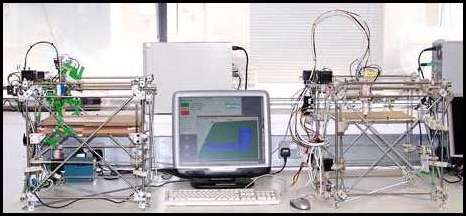
The inventor of the 'RepRap' machine believes that it will enable developing
countries to get a foothold on the manufacturing ladder.
The idea of a machine that could produce a copy of itself has intrigued some of
the greatest minds in history. Rene Descartes heads a list of philosophers,
mathematicians and physicists who have long pondered the potential of a self-replicating
machine. As have writers of science fiction, who have been also quick to warn of
the dangers of unleashing such a powerful technology upon the world. But for
both sets of thinkers, the reality of a self-replicating machine has lain
somewhere just beyond our reach.
Sitting in his office at the University of Bath, Dr Adrian Bowyer doesn't look
like an evil mastermind. Bowyer is a quietly spoken, slightly podgy, twinkle-eyed
55-year-old senior lecturer at the school of mechanical engineering and inventor
of the RepRap machine. Earlier this month at Cheltenham's Science Festival,
Bowyer and New Zealand scientist Vik Oliver unveiled a RepRap that had the
majority of its working parts "printed out" from an earlier prototype. Although
the RepRap was first assembled in 2006, this was the first time a parent and
child machine had appeared side by side.
Technically, the RepRap is a form of rapid prototyper, the kind used by
designers and engineers to streamline everything from aircraft to hairdryers,
but it's easier to think of it as a printer of three-dimensional objects.
Essentially, the RepRap works like the desktop printer you might have at home,
but instead of printing on paper, the RepRap makes hard copy in three dimensions
out of plastic from models designed on a computer.
Growth potential
Even before you get into the benefits of self-replication, the RepRap is already
an impressive achievement. Bowyer and an army of international helpers - all
operating under an open-source licence that lets them adapt and develop the
blueprint collectively - have managed to scale down the cost of rapid
prototypers from tens of thousands of pounds to around £250. But it is the
RepRap's ability to produce its own parts (which could then produce another
machine and so on) that has won Bowyer acclaim from the likes of the inventor
James Dyson and executives at Google.
Bowyer describes his RepRap as "potentially an extremely powerful technology"
that could "give everybody - ultimately - the ability to make virtually anything
for themselves in return for being helped to reproduce". For the moment it makes
crude plastic knick-knacks (sandals, coat hooks, door handles and fly-swatters),
but it has the potential to develop into something that could make much more
sophisticated artefacts, including the ability to lay its own circuitry.
The RepRap itself is a humble thing to see. It's small, little bigger in volume
than a portable television, barely more than a frame assembled from long pieces
of screw-grooved studding and a large number of plastic parts. At its heart is
the all important extruder, which is poised to squeeze out a small film of
molten plastic from a nozzle that is fed from a coil of white filament. It looks
vaguely like a cut-price textile machine.
Bowyer sets the nozzle to work, producing a simple coathook. Line by line, layer
upon layer, the RepRap begins its task. It is an agonisingly tedious process
that will take it almost two hours to "print out" each small part. It will take
hundreds of hours to make the parts for a "child" machine. Not that that should
temper your enthusiasm. If you think back, the first digitised images took hours
to process. Now, 20 years later, such things are commonplace, done in a flash on
a mobile phone.
Seen it before?
If you are still not convinced, perhaps it helps to take a longer view. The idea
of a self-replicating machine can be traced back to remarks made by the Queen of
Sweden to René Descartes, but they were more seriously explored in the 19th
century by Samuel Butler, who described a machine that could mimic the
biological process of plants in his novel Erewhon.
Science fiction writers have kept pace. Phillip K Dick, Arthur C Clarke and
Nobel-nominated Karel Capek have all toyed with the idea, before John Sladek
based his 1968 satirical novel, the Reproductive System, on a self-replicating
machine that goes wild. It set the scene for movies like the Terminator to tap
into fears of robots capable of reproducing and taking over.
Bowyer thinks his RepRap will prove much more benign. Besides, his machine can't
self-assemble and cannot yet reproduce all its own parts. These last two points
do make you wonder if the RepRap is a self-replicating machine at all. A lathe
could be used to make parts for another lathe; what's so different about his
RepRap? "You could see the whole of engineering as effectively a self-replicating
machine," Bowyer says. "It's very difficult to use a machine tool to make
another copy of itself, but RepRap is designed to make that as easy as possible."
Even though the RepRap is a doddle to operate, it remains difficult to build. To
do so you have to have an ability to write your own computer code, be confident
with a soldering iron and have some grasp of mechanics. It is believed that
there are already around 100 RepRaps in the world, mostly made by small groups
who share the skills necessary to build one. Bowyer thinks this model is
perfectly suited to small groups to develop products who would otherwise
struggle in normal economic circumstances. "It means that communities in the
developing world manage to get one foot on the rung of the manufacturing ladder,"
he says.
"Even in China you have to spend half a billion [dollars] to create a
fabrication line. You can pay people low wages but you have to make an enormous
capital investment in order to make things. The thing about RepRap is that it
allows you to make stuff with a very small capital investment. If you are a
community that has one, you can have several machines once you have got one and
what's more you can give a machine to your neighbours down the road and they can
do the same thing. [It's] a very powerful mechanism for elevating people from
the most extreme poverty."
Recycle, again
Soon, he says, communities in places like Africa will be able to download
instructions for a RepRap and use it to replicate further machines, almost
endlessly. Because the plans are open source, such communities will have to pay
no royalties for the patent. But, he adds, such a noble stance is inevitable: "I
realised that if you have a self-replicating machine, you've got to give it away
anyway because there's nothing to sell. If I knock it out for £1,000 you can
replicate it and knock it out for £900. Sooner or later you are down to the cost
of the raw materials."
And there is, he says, no fortune in that and, anyway, he doesn't want to spend
the rest of his life in court trying to prevent people from doing with the
machine the one thing it was designed to do. "You are brought to the point where
you have to say 'this is a self-replicating machine, the only sensible thing do
is give it way for free'."
The RepRap needs to get much faster before it can even begin to realise its
potential, but it is still early days for a device - even though it has been
dreamt of since the dawn of the enlightenment - and Bowyer is not done yet. Soon,
he plans to design a shredder for the machine, so old items created on the
RepRap can be returned to granules of plastic to be reused. Think about it, he
says: "You could shred your milk bottles and make a pair of sandals. What's more,
when the child grows out of the shoes, you shred them, add another milk bottle,
rescale the design and you have a new pair." If nothing else, the RepRap could
be the ultimate recycling machine.