Grains of truth
A performance of All The People In The World by James Yarker
Lyn Gardner, The Guardian, Wednesday September 17 2008
Every grain of rice in these pictures represents someone, somewhere, in the
world. Lyn Gardner visits a mind-boggling show in Birmingham
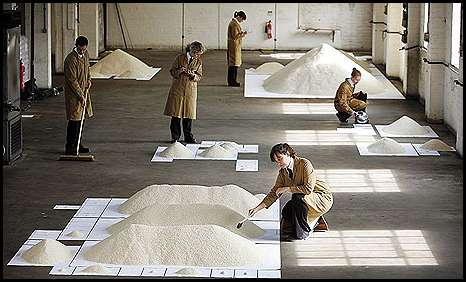
A performance of All The People In The World by James Yarker, in the AE Harris
Factory, Birmingham. Photograph: David Sillitoe
In a disused metal factory in Birmingham, workers wearing identical brown
overalls are scurrying about. One carefully weighs out a pile of rice. The
grains - each representing one of the 6.7 billion people in the world - are laid
on a pristine piece of paper. A small label is carefully attached. Meanwhile,
the factory PA announces that there is "a new statistic in the European zone".
People walk over to look at its label, which explains that this pile represents
all the people who auditioned for The X Factor series five. Beside it, a tiny
pile represents all the people training to be physics teachers in British
schools; beside that is a larger pile, showing the overall number of people who
applied to train as teachers in the UK. The X Factor pile is bigger.
There are heaps of rice across the factory floor. One mountain reflects the
entire population of India; another coffin-shaped heap represents all the people
killed in Rwanda in just six weeks, in the genocide of 1994; yet another stands
for all those children who will die this year of diseases for which a vaccine is
available. Other piles are smaller: a heap shaped like a bird's nest for all
those who attended the Olympics opening ceremony sits next to smaller mounds,
representing the number of people in the Georgian army and the population of
South Ossetia. On the next sheet are just two grains of rice: they are pistol-shooters
Natalia Paderina of Russia and Nino Salukvadze of Georgia embracing on the
Olympic medal podium. Back in the European zone, the mound symbolising all those
children who become obese in the EU each year is dwarfed by the mountain showing
the number of people who will visit McDonald's today.
These grains of truth are part of an ever-changing performance-cum-installation
by Stan's Café, an experimental theatre company. The brainchild of its artistic
director James Yarker, Of All the People in All the World is a stunningly simple
idea that doesn't just tell you the facts and figures about various population
statistics, but shows you them instead, in an ever-changing narrative. Each pile
tells its own story, but is given context by the mounds that surround it. So the
one that indicates the number of people in prison worldwide is set against the
number of people who choose to live in gated communities in the US; the number
of those who died in the Titanic disaster is juxtaposed with all those involved
in the production of the Titanic movie.
Yarker hit upon the idea after trips abroad in his 20s. "I was struck by what a
big place the world was and how many people were in it. It made me question my
own place. I knew there were six billion people in the world, but I didn't know
what that actually meant. Then one day I was walking down a street in Birmingham
with lots of grocers and I realised rice was the answer. It's small, cheap -
well, until recently - and if you up-end it, it looks like a tiny person. I
bought a large bag, rushed home and got out the kitchen scales. I was a bit
deflated to work out that I'd need over 100 tonnes to represent all the people
in the world."
In fact, the Birmingham incarnation of the show uses 112 tonnes of American long-grain
rice. It is only the second time the company has been able to mount the full
version of the work; the other, in Stuttgart in 2003, required only 104 tonnes
of rice because the world's population was then smaller. At one point, the
spiralling cost of rice looked set to scupper the project: the amount required
is around 1/14 of the UK's entire yearly rice import. When the show is finished,
it will be washed and sold back to the supplier.
The most fascinating thing about Of All the People is that a piece based on cold
statistics can be so moving. Its success may lie in the fact that it creates its
own world within a world, with its army of workers engaged in their never-ending
task. Perhaps it's because the piles create a real sense of drama by responding
to news events; perhaps it's because, as you enter the space, you are given a
single grain that represents you, which you hold in your hand as you wander this
cascading mass of humanity.
"People get really involved," says Yarker. "It's about numbers - but it's also
not about numbers at all. It is about finding your place in the world. When a
grain of rice becomes detached from its pile and ends up on the floor, often the
person who finds it brings it to us and says, 'I've rescued this person. In
which pile do they belong?' I think the show taps into the empathy we all have
for each other." He pauses. "Of course, there are jokers who like to add
themselves to a pile. The one representing people who have walked on the moon is
a particular favourite."
Yarker and the team are aware that statistics can be twisted. "We never use
figures we can't verify," says Yarker, who recalls that an attempt to represent
all the people who have played Doctor Who had to be ditched after the figures
were continually disputed by fans. "Sometimes we do set up conflicting
statistics, such as the number of people estimated to have been killed at
Chernobyl - by the Russian authorities and by the UN."
Inevitably, siting the piles is a political act. I am shocked by the fact that
the one for the number of people who died from smoking in 2007 is insignificant
next to the mountain of teenage smokers in China. "People can get quite angry,
because what we're doing confounds their view of the world," says Graeme Rose, a
regular participant, who points to the pile representing those who died in the
bombing of Dresden in 1945. It towers over the pile for the Coventry Blitz. "It
is easy to get the statistics for death," adds Yarker. "But we've always wanted
the show to be about joy, too, and the things people do that make us laugh."
As I leave I notice that the mound for the number of people born in the world
last year is bigger than the one for those who died. I step out with a smile on
my face, suddenly aware that I may be a single grain of rice but I'm also part
of something much bigger.