Original speed demon: The first car to hit 100km/h
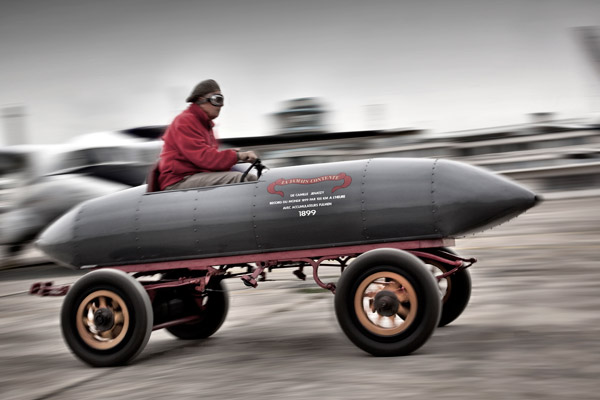
La Jamais Contente (Never Satisfied), the first car to top 100km/h.
Don Sherman, The Sydney Morning Herald, 28th January 2011
The Red Devil set records once thought unachievable, writes Don Sherman.
He was an electric-car pioneer - and the first man to break the magical 100km/h barrier -
but Belgian Camille Jenatzy earned little lasting acclaim for his achievements.
This son of a wealthy rubber-goods manufacturer was one of the first car enthusiasts and the
designer, engineer and driver of La Jamais Contente (Never Satisfied), the first car to top 100km/h.
Jenatzy, nicknamed "Le Diable Rouge" (The Red Devil) because of his flaming red hair and beard,
was the original speed demon.
The rakish Jenatzy loved the thrill of competition and saw racing as an excellent means of promoting
the electric cars he was manufacturing for Parisian taxi-cab use.
Beaten in a timed event by an electric Jeantaud driven by Count Gaston de Chasseloup-Laubat,
Jenatzy responded in kind at the Parc Agricole d'Acheres, where Paris's sewage was dumped.
The two rivals then volleyed the land-speed record upward towards the magical mark, with de
Chasseloup-Laubat achieving 92.7km/h before the fearless Belgian delivered the coup de grace on
April 29, 1899.
Scrutinised by Automobile Club of France officials, Jenatzy whistled through the timing trap at
105.9km/h.
When asked to describe the feeling of travelling faster than physicians of the day believed the
human body could endure, Jenatzy said: "The car in which you travel seems to leave the ground
and hurl itself forward like a projectile ricocheting along the ground."
"As for the driver, the muscles of his body and neck become rigid in resisting the pressure of the air;
his gaze is steadfastly fixed about 200 yards ahead; his senses are on the alert."
The cars fielded by Jenatzy and his rival pressed the limits of late-19th-century technology.
Both attempted to cut drag with aerodynamic bodywork that appeared inspired by the day's airships.
Attached to a wooden undercarriage, Jenatzy's fuselage was tapered at both ends. While that
provided an excellent means of shrouding the 100 two-volt batteries carried on board, a driver
protruding out the top and the chassis slung below offset any streamlining benefits afforded by the
torpedo body.
To save weight, Jenatzy's coachwork consisted of riveted sheets of partinium, an alloy of aluminium,
tungsten and magnesium. Two electric-drive motors were mounted on the rear axle to drive the
back wheels with a combined 50kW of power.
Jenatzy was also ahead of the curve in his use of pneumatic tyres, instead of solid rubber.
They were provided by two other pioneers, Edouard and Andre Michelin.
La Jamais Contente is displayed at the Musee National de la Voiture et du Tourisme (National Car
and Tourism Museum). Veuve Camille Jenatzy, the record setter's widow, donated his racer for
display in 1933. It resides behind four locked doors shrouded by what was the castle's main kitchen
fireplace.
Except for a few dents and missing electrical gear, La Jamais Contente is in excellent condition.
Considering the car's historical significance, it's no surprise that enthusiast Christian Wannyn was
denied when he asked the museum if La Jamais Contente could be released to make a few public
demonstration runs.
Wannyn did, however, convince the French cultural minister that constructing an accurate replica
of this landmark car was in the nation's best interests.
He also uncovered an interesting fact about Jenatzy: the never-content name had nothing to do
with Jenatzy's lust for speed but was instead a jab at an annoying mother-in-law. Wannyn also
doubts that Jenatzy's death while hunting in 1913 was an accident because the shooter was married
to Jenatzy's mistress.
The revival car was completed in 1994 and soon thereafter, Wannyn achieved his goal of
demonstrating La Jamais Contente before a crowd at the Montlhery Autodrome, 24 kilometres
south-east of Paris. While this steeply banked 2.6-kilometre speed bowl lacked the room to top
Jenatzy's record, Wannyn came close with a documented 93km/h.
That's considerably more velocity than I was able to achieve on the fenced-in apron outside the
Air and Space Museum at Le Bourget. After the car was wheeled outside, the climb up into the red
leather seat felt like mounting a fire engine. To properly commemorate Jenatzy's feat for the
camera, I wore a red jacket, rotated my flat cap and slipped on vintage goggles.
A tiller consisting of one horizontal and one vertical handle mounted on a vertical shaft guides the
front wheels. There's a hinged pedal connected to a rod that moves an electrical switch to control
the amount of electrical power sent to the wheels and a switch on the dash to select forward,
neutral or reverse propulsion modes.
Without explaining exactly why, Wannyn instructed me not to use the long lever that engages the
(rear-wheel-only) brakes. Instead, if slowing quickly became necessary, I was supposed to switch
the electric motor into reverse and step down on the power pedal.
Unlike modern electrics noted for their instant torque and powerful initial acceleration, this car
oozed from rest with glacial verve. In the space available, it mooed to 50km/h or so, gliding over
the concrete joints as smoothly as a baby carriage.
Neck strain from air pressure wasn't an issue but my senses felt on the alert. To avoid stuffing
Wannyn's pride and joy into the fence or one of the nearby fighter planes, I lifted early and left
ample room for a gentle turn following each speed run.
Crouching low in the saddle is harder than you'd imagine with a tiller buried in your chest. But
with a bit of squinting, I could picture the future Jenatzy envisioned beyond his car's silver
nose-cone: a smooth stretch of road, a blurred crowd cheering his progress and the steady pull
of electric propulsion.
From that vantage, cars could only get quicker and better.