Who's turning 50?
Fuel's errand ... the Devrim was the little engine that couldn't.
Tony Davis, The Sydney Morning Herald, 18th February 2011
It's more famous in Turkey than most places, admittedly. And it's probably famous there mainly for
making one of the most embarrassing product debuts in automotive history - which we'll come to shortly.
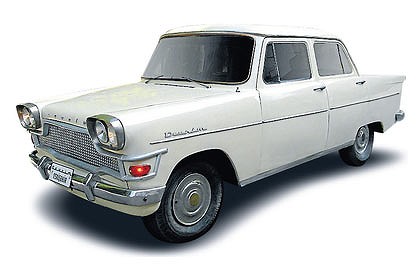
Not only is the Devrim car celebrating its half-century but its unusual gestation is the subject of a
feature film. This is despite only four examples ever being made and despite, well, that embarrassing
unveiling. Which we'll come to shortly.
Well, come on - a bloke should be allowed a few blatant journalistic hooks if he's trying to make
people interested in an obscure Turkish sedan.
The only other car that springs to mind as inspiring a "making of" feature film is the 1948 Tucker,
which was later known as the Torpedo. It was considered Hollywood material because it had a
radical design and a charismatic man behind it who managed to spin the story that he was going to
smash Detroit.
When he didn't, he spun the story that Detroit's skulduggery had smashed him.
And the Devrim?
The story started when Turkey had a general election - which is to say, an election involving only
generals - and Cemal Gursel was installed as president.
General Gursel decided it would be good for morale if Turkey designed and produced a car all of its
own. Ideally within four months, in time for the 1961 Republic Day celebrations.
Despite the ludicrous time-frame, only about two dozen engineers were drafted into the project.
They had limited resources and even more limited experience. Some of them had never driven a car,
let alone designed or engineered one, so didn't necessarily know quite what they were trying to achieve.
Although said to be thwarted at every point by bureaucracy, they worked around the clock to pull
apart any cars they could get their hands on, then reverse-engineer what they'd learnt into a
prototype sedan known as the Devrim. That's Turkish for "revolution".
The Devrim looked vaguely like a small piece of late-'50s Americana and was powered by a 2.0-litre
engine developing about 38kW.
Four were built; the two most finished examples were put on the train to Ankara for the celebrations
but even they weren't that finished. One was reputedly painted en route.
There hadn't been time to make engineering drawings, either, meaning series production was going
to be difficult. Still, in front of a large and enthusiastic crowd, the president stepped into the new
Turkish sedan outside the national parliament. A dream was about to be realised. Or not.
One hundred metres later, the car spluttered to a halt and the embarrassed president jumped out,
presumably muttering the Turkish word for "bugger".
He climbed into the second car and, although that went further, the damage was done. Devrim jokes
circulated and the president himself threw in a few jibes for good measure.
The problem was simple and minor: in the rush, the first car hadn't been fuelled. General G is quoted
(in one translation) as saying: "The team developed the automobile with Western mind; however,
forgot to supply the fuel with Eastern mind."
The event spelt the end of the Devrim, so at least the lack of engineering drawings no longer mattered.
In concept, the Devrim was nothing new. The Holden and the VW Beetle (pre-war and postwar
versions) are among many cars pushed by governments with at least one eye on nation-boosting.
Sadly, the Devrim was more a nation-reducing exercise.
In 2009, Turkish director Tolga Ornek made Chariots of Revolution (or Devrim Arabalari).
Some might worry about a film set mostly inside the Eskisehir Train and Locomotive Manufacturing
Plant of State Railroad Directorate but it has received rave reviews.
Now to find an English subtitled copy ...
Here is a review of the movie written by Haluk Direskeneli from the Turkish Weekly:
Chariots of Revolution "Devrim ARABALARI"
by Haluk Direskeneli
Thursday, 14 May 2009
"Chariots of Revolution" is the name of a recent movie, which depicts the sad story of first attempt to manufacture the first Turkish automobile. These were 4- each passenger cars which were manufactured by 23 Turkish engineers within 130 calendar days in year 1961.
It was a perfect example of reverse engineering of a reputable US automobile as well as good project management, utilization of available human resources. Engine block was cast elsewhere under the supervision of the team, and machined somewhere else.
We view gratification of working class as well as local engineering skills, in a period of scarce material resources, difficult transportation means and difficult age of telecommunication. Sincerely speaking, your humble writer could not avoid to stop his tears while viewing the movie.
In year 1961, new administration decided to allocate necessary funds to build the new local car. The President Mr. Cemal Gursel, former Chief-of General Staff, was well aware of prevailing transportation difficulties in the armed forces, and the uneasy situation of unnecessary dependence to foreign military vehicle manufacturers. He sincerely encouraged the local fabrication.
"Chariots of Revolution" is one of the best movies Turkish cinema industry ever created, with its fascinating screenplay, well-built and portrayed characters, and an inspiring as well as a sad story.
It is the story of the Turkish attempt to build a "national automobile" in the 1960s, shortly after the military coup that replaced a "pro-American authoritarian democracy" with an "independent-minded libertarian junta". Main characters are the idealist engineers of the State Railroad Directorate, who undertook the almost impossible task of designing and building of an automobile from scratch only in 130 calendar days.
Director and his well-picked cast takes us through the 130 calendar days of hard-work that produced the "Devrim" (Revolution) automobile in new Turkish political environment that followed the unavoidable military coup. Both the screenplay and direction are praiseworthy, and the Director Mr. Tolga Ornek deserves much of the credit for keeping it simple, subtle and fascinating.
Unlike most other contemporary Turkish movies full of popular names and pretty faces, all the actors are "actors", each with well-deserved respectability and genuine talent. Everyone does a good job in making their characters real and fascinating enough.
In the movie, engineers were brought together in Eskisehir Train and Locomotive Manufacturing Plant of State Railroad Directorate. They were given 130 calendar days to manufacture the new local automobile to show in the Republic day, 29th October 1961, to general public that local human intelligence can create a local output in real terms.
The team dismantled a relatively new US automobile with reverse engineering principles, they designed a new car to meet local conditions within that tight schedule. They were obstructed by the upper public officials on every step in project execution. Media created a high negative tone accusing them to waste public resources.
In the end the team completed fabrication of first two local cars by 29th October 1961 and transported the cars by train from Eskisehir plant to Ankara to join the Republic day celebrations. However due to security reasons in train transportation, they unloaded the fuel tank, then in the rush of meeting tight schedule they forgot to refill the fuel tank in first test drive in the National Parliament. Hence media ridiculated them. Project was forgotten in the end until the new movie release to pay respect to those early pioneers of local engineering.
It is your writers sincere feeling that every young engineer faces similar challenge similar discouragements in design/ manufacturing locally.We all have our story similar to "Chariots of Revolution" in our early professional lives. Your writer had similar projects in fabrication of high capacity turret lathe, high capacity cement furnace fabrication, all first of its kind completely fabricated through reverse engineering, built in local environment with available local resources.
It is a pity that those early initiatives were severely curtailed by upper management due to high cost of early development period. We are not ready to spend on R&D. It is sad to recall the dialog that "Each and every success is to be severely penalized".
We have young engineering and intellectual capability to design, manufacture, construct and smoothly operate high capacity local indigenous coal firing thermal power plants. These intellectual capacities are not employed for the correct action.
We need to encourage these efforts, put more resources in order to realize more local design, and fabrication. Every major country puts info force the major local design capabilities to use the available local coal resources, as well as local hydro, wind, solar. We also need to educate and create our own personnel in nuclear technology to employ them in future.
We must educate, train and employ our engineering staff in thermal power plant design. We need to have Thermal Power Plant design course in the 4th year of undergraduate mechanical engineering programs, in our major Technical Universities. We can only be free in energy supply security by employing more and more local engineering capability.
"Chariots of Revolution" is a great movie paying respect to our early pioneers of our engineering history. These chariots created a real revolution in the intellectual minds. Film will be a real cult, a must-see production for all times in the cinema history.
Haluk Direskeneli is an Ankara based Energy Analyst